
Why Your Intuition Isn't the Same as Anxiety
There's a sentence I heard myself repeat more times than I can count, back when all of this started: maybe I'm just anxious. Maybe this is all in my head. It became a kind of reflex, almost faster than the feeling itself, a way of shutting the door before I'd even looked at what was behind it.
I think a lot of women do this. We've been taught, one way or another, that our instincts need a permit before they're allowed to speak. So the moment something feels off, the first thing we do isn't investigate it. It's interrogate ourselves instead.
Two Feelings That Feel Almost Identical
Here's the part that made this so hard to untangle for me: intuition and anxiety can feel exactly the same in the body. The same tight chest. The same racing thoughts at two in the morning. The same low hum of unease that won't quite let you settle.
But they don't come from the same place, and once I understood the difference, I couldn't unsee it.
Intuition starts from an observation. It says: I noticed something that doesn't add up. A changed pattern. A story that shifted slightly between two tellings. A silence where there used to be an easy answer.
Anxiety starts from a fear. It says: I'm afraid of losing this, so I'm scanning for danger everywhere, whether or not it's actually there.
Both are real. Both deserve to be taken seriously. But they ask for completely different responses, and confusing one for the other is exactly how I spent months either dismissing something true or spiraling over something that wasn't.
How I Learned to Tell Them Apart
I wish I could say I figured this out quickly. I didn't. What helped, eventually, was a simple habit: pausing before reacting, and asking myself two separate questions instead of one.
The first was concrete: what did I actually observe? Not a feeling, a fact. A specific behavior, on a specific day, that I could describe without adjectives attached to it.
The second was harder to sit with: what am I afraid of right now, and is that fear about something that's actually happening, or about something that happened before, somewhere else, to someone I used to be?
Sometimes the answers lined up. The thing I'd observed and the thing I was afraid of were the same thing, which meant the fear had somewhere real to land. Other times they didn't. I was afraid of something my mind had built entirely on its own, dressed up to look like evidence.

Neither Answer Makes You Wrong
I want to say this clearly, because it took me a long time to believe it myself: realizing a feeling comes from anxiety doesn't mean you invented it out of nothing, and it doesn't mean you're broken or too sensitive. Anxiety usually comes from somewhere honest too, an old wound, a pattern you've lived through before, a nervous system that learned to stay alert because it once had good reason to.
The goal was never to shut the feeling down. It was to understand where it was coming from, so I could respond to it with the right kind of attention instead of either ignoring it completely or letting it run the whole show.
A Small Practice That Helped
When something felt off, I started writing two lines before I let myself react to either of them. One line for what I'd actually seen or heard, stripped down to just the facts. One line for what I was afraid it meant.
Seeing them separated on paper did something that just thinking about them never could. It made the difference visible. Some days the observation held real weight on its own. Other days, once I separated it from the fear wrapped around it, there wasn't much left to hold onto.
Neither outcome was a failure. Both were information, and information was what I needed most, more than reassurance, more than a quick answer either way.
If This Sounds Familiar
If you've been going back and forth between certainty and self-doubt, wondering whether what you're feeling is real or whether you're the one creating a problem out of nothing, that exhausting loop is exactly what this kind of confusion feels like from the inside.
I built a small set of tools for working through this more slowly and honestly than a single sleepless night usually allows. If it would help to have something more structured to walk through, I put it together in a free guide, along with the questions I actually asked myself before I trusted either the fear or the feeling.
Get the free guide:→ The Seven Invisible Signals

Marta Romero
I'm American, I've lived most of my life on the East Coast, and I still believe in writing things down by hand when a thought won't leave me alone. I wrote The Voice You Can't Ignore under a pen name, not to hide, but to protect the people who are still part of my life and didn't ask to be part of this story too.
If This Helped, There's More
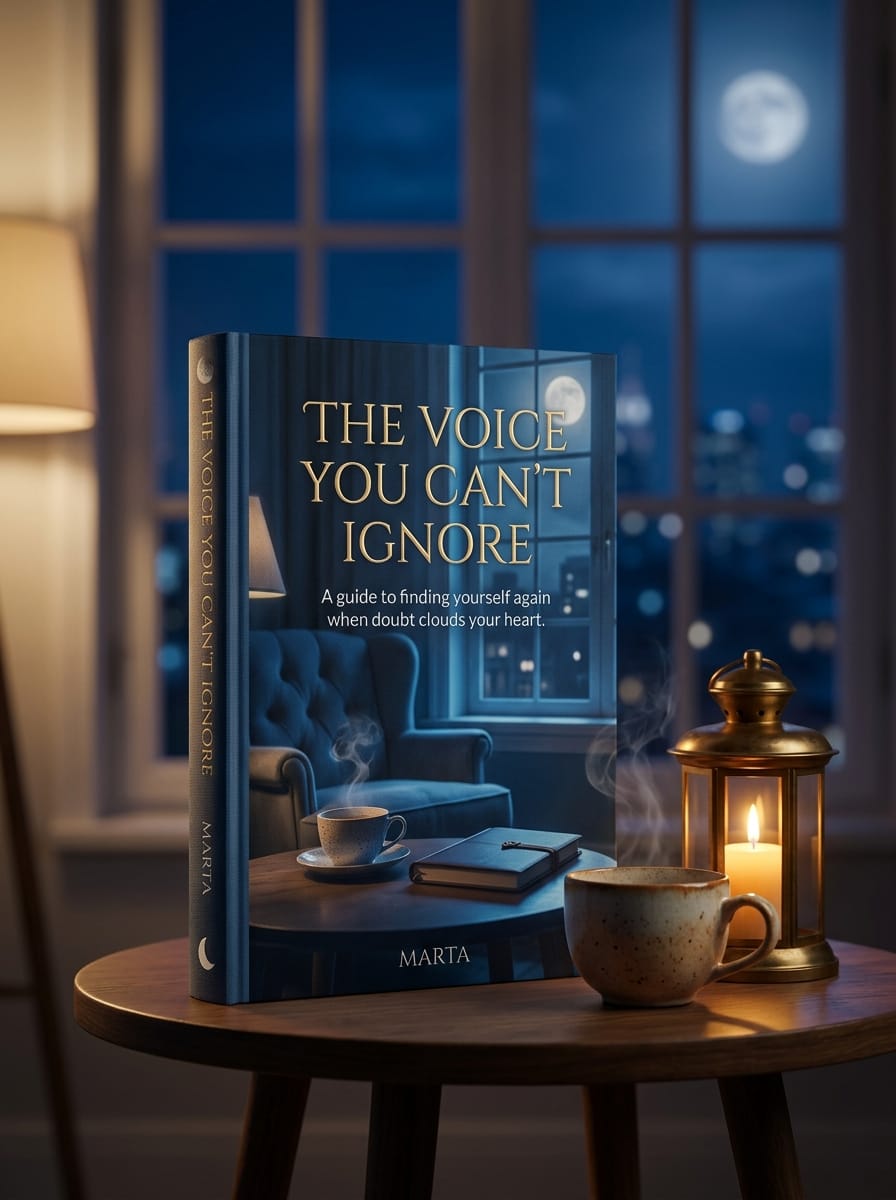
This article is one piece of a bigger picture. The full book walks through all of it, along with the journal I used to stay honest with myself along the way.
Get New Chapters and Reflections
By subscribing, you agree to receive occasional emails from Marta Romero. You can unsubscribe at any time. See our [Privacy Policy].

Books and resources for women navigating relationship doubt, written from lived experience, not clinical distance.
Disclaimer
Newsletter
Get new chapters, reflections, and the occasional honest thought, straight to your inbox.
By subscribing, you agree to receive occasional emails from Marta Romero. You can unsubscribe at any time. See our Privacy Policy
By Marta Romero